
Monthly Executive Freight Update
Stay ahead of month-to-month market volatility with Uber Freight's Monthly Executive Freight Update. Get timely, actionable insights on rate movements, fuel trends, and cross-border network capacity to keep your logistics operations agile.
Vertical pulse: Actionable insights for your industry
Market pulse
Diesel prices remain high, but they’re not the only cost driver
October diesel held at $6.25/gal, keeping fuel surcharges elevated at 84¢/mi.
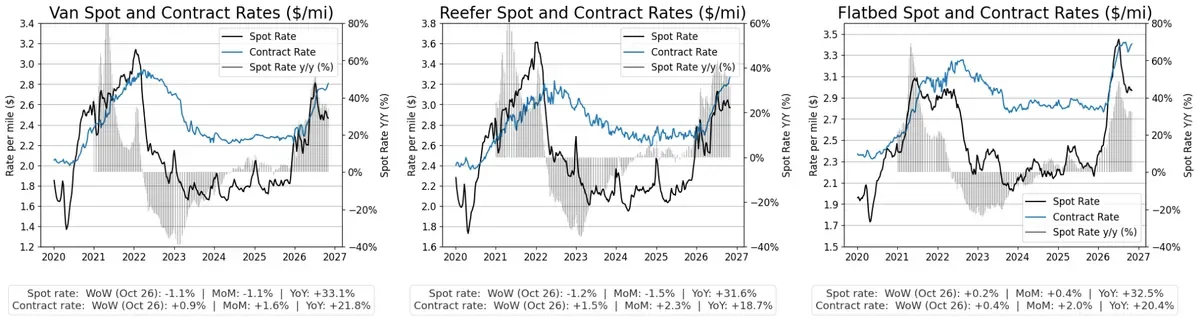
Spot dry van rates rose 2.8% MoM, while contract rates grew 1.5–1.7% MoM
LTL PPI surged 4.2% MoM to an all-time high (+19.8% YoY)
All-in intermodal rates are running ~20% higher YoY
Routing guides stabilized as contract rates increased
First Tender Acceptance rose to 79% in October, up from 78% in September
Routing Guide Compliance edged up to 86%, up from 85%.
Capacity is returning, signaling 2027 stability
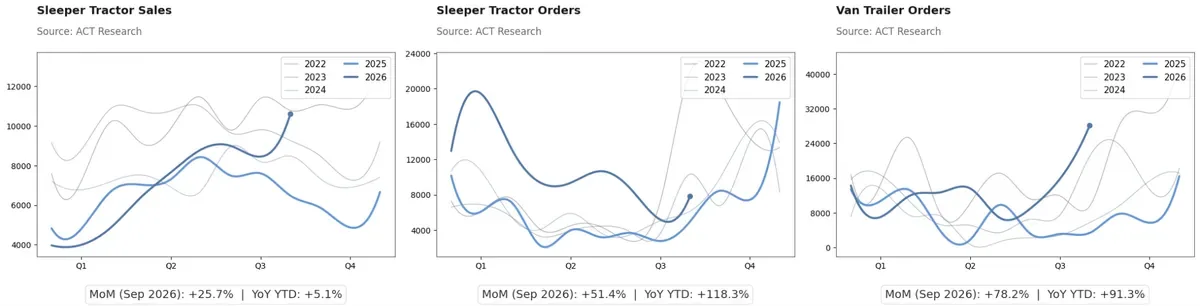
September sleeper tractor sales jumped 25.7% MoM (+64% YoY)
Trailer orders surged across van (+78%), flatbed (74%), and reefer (104%).
Equipment inflow signals meaningful supply expansion and rate stability in 2027.
What to expect for the rest of peak season and early 2027
Severe spot market cost premiums:
Fuel surcharges alongside constrained supply will drive sharp spot spikes across FTL and intermodal in December as holiday grocery and retail volumes peak, mirroring the tightness observed ahead of July 4.
Uncommitted freight falling outside primary routing guides will incur heavy cost penalties.
Temporary service degradation:
Tender rejections will surge in December, leading carriers to reject non-contracted, short-notice, or inconsistent freight.
Elevated highway rates will accelerate diversion to intermodal networks, driving up rail dwell times, slowing equipment turnarounds at key hubs, and narrowing the truckload-to-rail spread.
Beyond peak season:
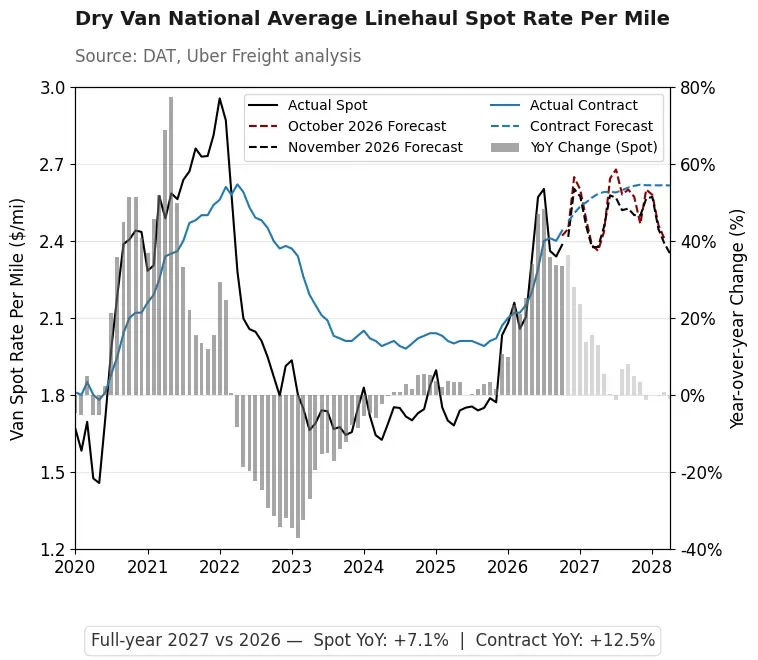
Aside from seasonal fluctuations, spot volatility is expected to stabilize in 2027 around current levels—establishing a higher floor than the past three years.
Spot rates are projected to grow by 7% YoY in 2026, primarily concentrated in Q1, while contract rates are expected to increase by 12.5% as expired contracts are renegotiated at higher rates.
Carriers will leverage current diesel costs and tight capacity to push baseline contract rates upward as they reset to match elevated spot pricing.
Protect your network and manage cost inflation with proactive strategies
Run targeted mini-bids on broken lanes: Focus immediate procurement on weekly or monthly mini-bids instead of network-wide annual RFPs, targeting underperforming lanes to restore routing guide integrity before peak season. Space mini-bids to avoid carrier bid fatigue.
Secure core contract rates immediately: Lock in primary carrier volume commitments now on critical high-density lanes to protect capacity through year-end.
Dynamically re-evaluate modal mix: Benchmark truckload cost and service against intermodal to ensure freight moves on the most cost-efficient mode without sacrificing service.
Adopt a hybrid cross-border transload model: Transition away from pure direct-trailer border crossings by integrating strategic cross-dock transloading facilities, eliminating border bottlenecks and freeing up constrained domestic trailer capacity.
Sources
American Oil & Gas Reporter — Daily Commodity Futures & Cash Crude Market Analytics[2].
Gasoline and Diesel Fuel Update - U.S. Energy Information Administration (EIA) — Weekly On-Highway Diesel Fuel Prices (Midwest PADD2 & National)[11].
Supply Chain, Logistics, and Trucking Media and News - FreightWaves — SONAR Market Updates, Reefer Rejections & Cleo OTIF Failure Report[3].
The Freight Economist | Uber Freight — Weekly Market Update: Spot Rates, Contract Rates, Intermodal vs. LTL Pricing & Fuel Surcharges[4][8].
UberFreight_Weekly Spot Rate Index 2026 - W43.pptx — National & Regional Rate Index Benchmarks (Week 43)[5].